
Before we start: a disclaimer
This article is a guide, not a substitute for proper instruction. If you can learn with a music teacher — even for a handful of lessons — do that. A good teacher will catch bad habits you can't see, tailor things to your hands and your goals, and save you months of wandering. Think of this post as the map you keep in your pocket, not the person walking beside you.
Most "learn guitar" articles start with a pep talk about how anyone can do it. You already know that, or you wouldn't be here. So let's skip to the part people actually get stuck on: what to do first, in what order, and what to ignore.
Step 0: If You Can, Get a Teacher
I'm putting this before everything else because it's the single highest-leverage decision you can make.
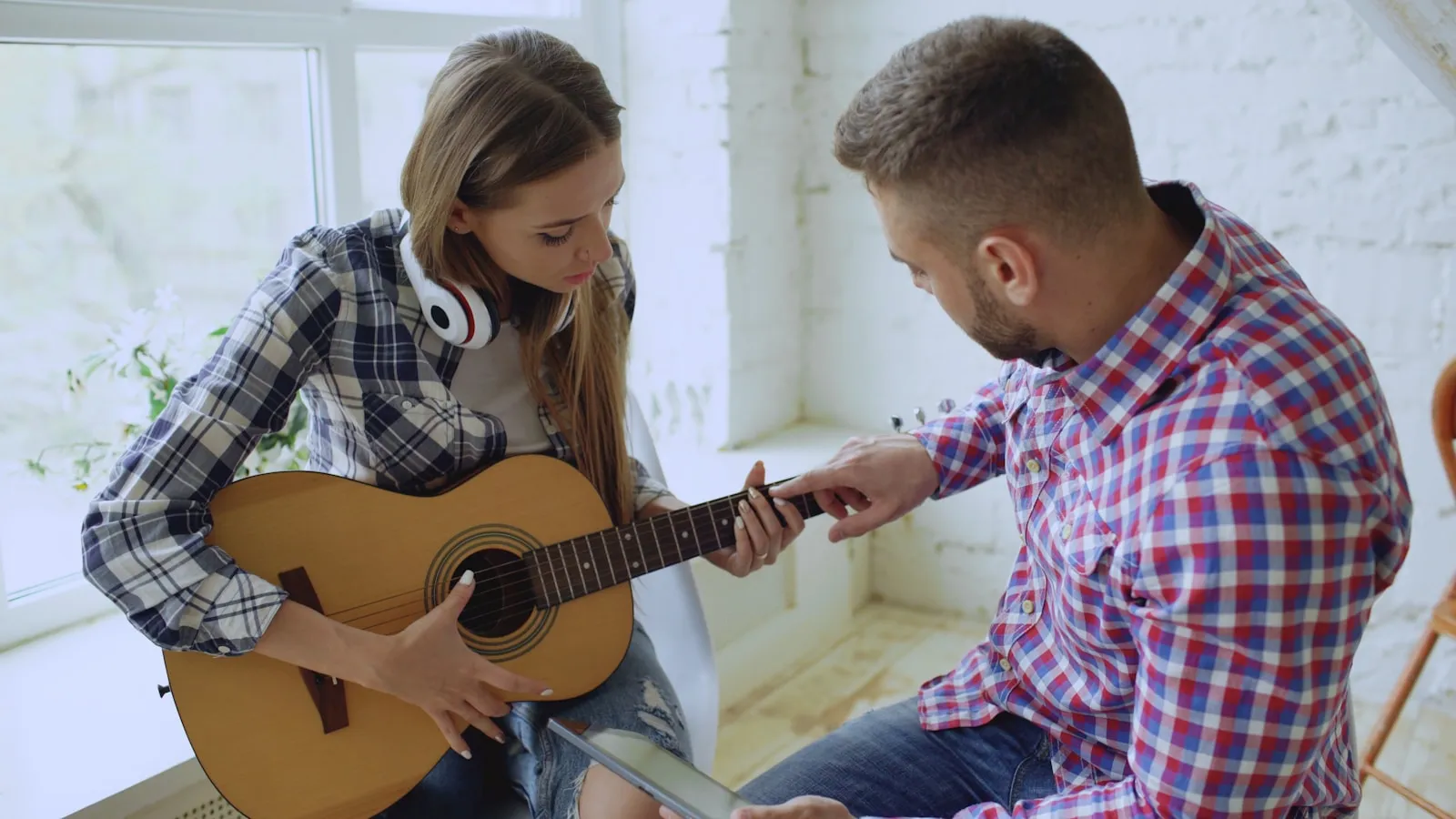
A teacher watches you play. That sounds obvious, but it's the whole point — YouTube can't see that your thumb is wrapped over the neck, that your wrist is bent at an angle that will hurt in three months, or that you're pressing four times harder than you need to. Those things are invisible to you and glaring to someone who's taught a hundred beginners.
📷 Photo by Vitaly Gariev on Unsplash
You don't need weekly lessons forever. Even one lesson a month, with focused practice in between, beats years of self-taught guesswork. If lessons genuinely aren't an option — cost, schedule, location — that's fine. Plenty of good players started alone. Just be honest with yourself about checking your technique against video of good players, regularly.
Everything below works either way. It just works faster with someone correcting you.
Step 1: Get a Guitar You Can Actually Play
Not a good guitar. A playable one. There's a difference.
A beginner guitar needs low action (strings close to the fretboard), a straight neck, and tuners that hold pitch. That's it. A £150 guitar with those three things will serve you better than a £1,000 guitar with strings a centimetre off the fretboard.
If you're borrowing or buying used, have someone who plays check it over — or take it to a shop and pay for a basic setup. A setup on a cheap guitar is the best money a beginner can spend. High action has quietly ended more guitar careers than lack of talent ever did, because the player concluded their fingers were the problem.
Acoustic or electric? Whichever excites you. You'll practice the one you want to pick up. (Electric is physically easier on the fingers; acoustic needs no amp. Both are fine.)
Step 2: Learn Five Chords, Badly
Your first chords: E minor, A minor, G, C, D. Thousands of songs live inside those five shapes.
Here's the part nobody says clearly enough: they will sound terrible at first, and that's not feedback about you. Buzzing strings, muted notes, fingers that refuse to land where you told them — all of it is normal, all of it passes. Your fingertips will be tender for a couple of weeks until calluses form. Also normal.

📷 Photo by Jefferson Santos on Unsplash
Don't wait for one chord to be perfect before starting the next. Learn the shapes roughly, then spend your time on the thing that actually matters:
Step 3: Practice the Changes, Not the Chords
Holding a G chord is easy after a week. Getting to the G chord from C, in rhythm, without a three-second pause — that's the skill. It's also the difference between "knowing chords" and playing music.
The classic exercise is the one-minute change: pick two chords, switch between them as many times as you can in sixty seconds, count it, try to beat the number tomorrow. It's boring and it works. Two chords at a time, a minute or two each, every day.
Sloppy-but-in-time beats perfect-but-late. Every time. A listener will forgive a buzzy string; they won't forgive the song stopping.
Step 4: Play Songs Immediately
Not after you're "ready." Now — within the first two weeks.
Pick a real song you love that uses your five chords (look up "two chord songs" and "three chord songs" — the lists are long and full of famous names). Play it slowly. Sing if you dare. It will be rough, and it will also be music, and that feeling is the fuel for everything else.
People who only do exercises quit. People who play songs keep going. Exercises are the vegetables; songs are the meal.
Step 5: Twenty Minutes, Most Days
The maths of practice is brutally simple: daily beats occasional, even when occasional is longer. Twenty focused minutes every day will outrun a three-hour Sunday session, because your hands forget slowly but they forget.
A simple session shape:
- 5 minutes — chord changes (the one-minute drill)
- 10 minutes — a song, or the hard part of a song
- 5 minutes — anything you enjoy, as a reward
The hardest part isn't the practice — it's remembering to start. Pick a fixed time, attach it to something you already do (after dinner, before the evening scroll), and set a reminder. This is exactly the problem TempoFix was built for, but honestly, a phone alarm works too. Whatever removes the daily decision.
What to Ignore (For Now)
Music theory, scales, modes, gear upgrades, "which pick is best" debates, barre chords in week one. All of it has its time; none of it is now. The beginner phase has exactly one goal: make playing feel normal. Chords, changes, songs, repeat.
Somewhere around month two or three, progress will feel invisible. It isn't — it's just moved under the surface. That's the phase where most people quit, usually right before it clicks. Play through it. Ideally with a teacher checking your form, but either way: play through it.
Building a daily habit is most of the battle. TempoFix sends practice reminders, tracks your streaks, and has a built-in metronome and chord library — everything a beginner needs in one app, free on iOS and Android.
Discussion
Comments coming soon
We're setting up our comments system. Check back shortly!